Portfolio
[ tax-loss harvest ]
Sell loss lots clear of wash sales and stage replacements that preserve the intended exposure.
Bespoke turns repeatable investment decisions into governed workflows. Each workflow brings together the right context, applies your rules, and prepares the work for advisor approval before carrying it into the systems you already use.
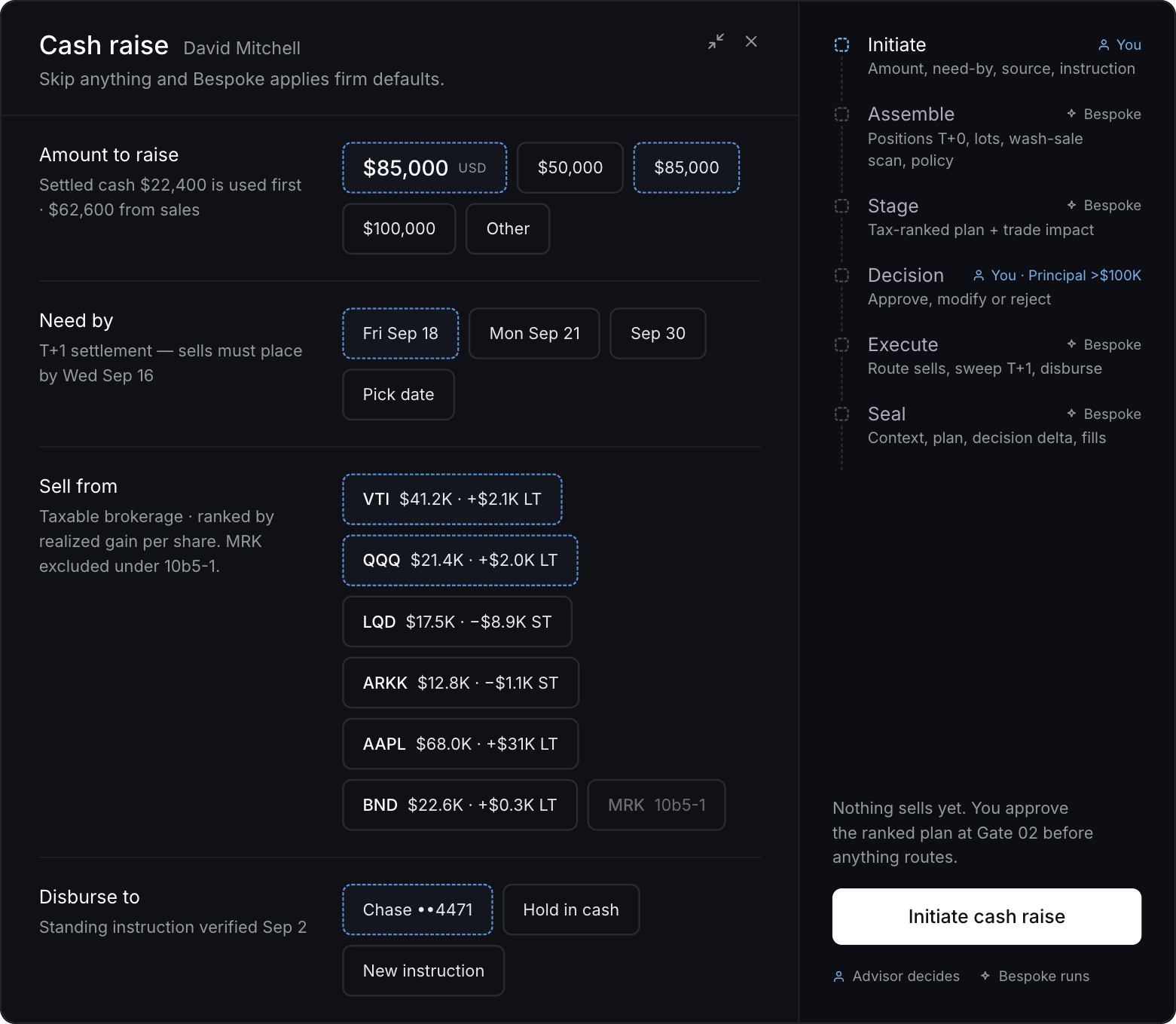
Workflows start on demand or automatically in response to market signals, client requests, calendar events, or portfolio changes.
Bespoke brings together the client, portfolio, market, and firm context needed.
Your models, policies, constraints, and investment criteria determine the appropriate action.
The recommendation is sized to the account and staged for the advisor to approve, modify, or reject.
Once approved, the workflow carries the work into your existing portfolio systems, CRM, and client communications.
Every workflow defines where the advisor’s judgment is required and who is accountable for it.
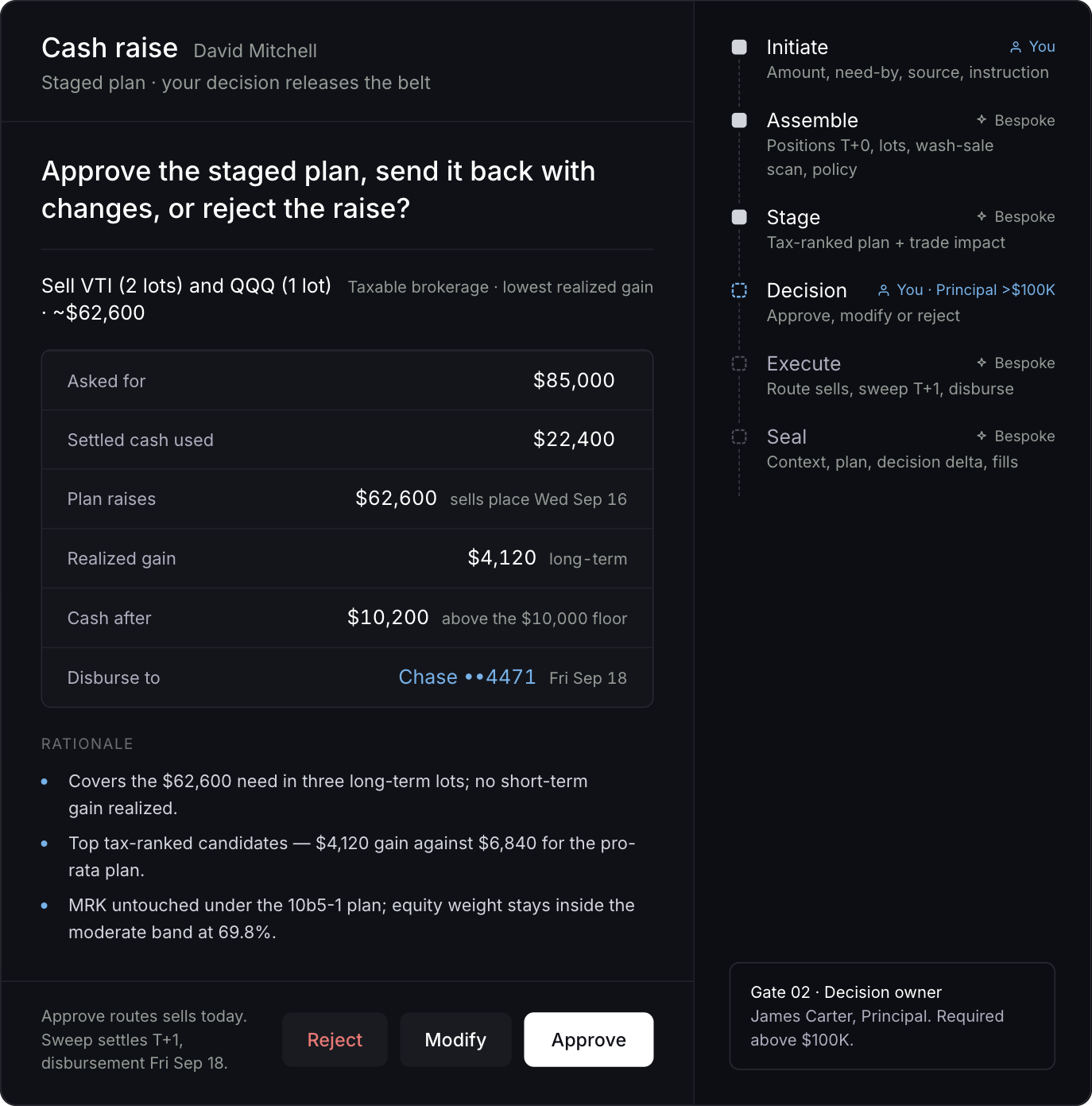
Every staged recommendation waits for the advisor’s decision.
Every approval, modification, or rejection is captured as part of the workflow.
Approval gates identify the person responsible for the decision.
Every consequential step is captured as the work happens, creating a complete record from the original signal through approval and execution.
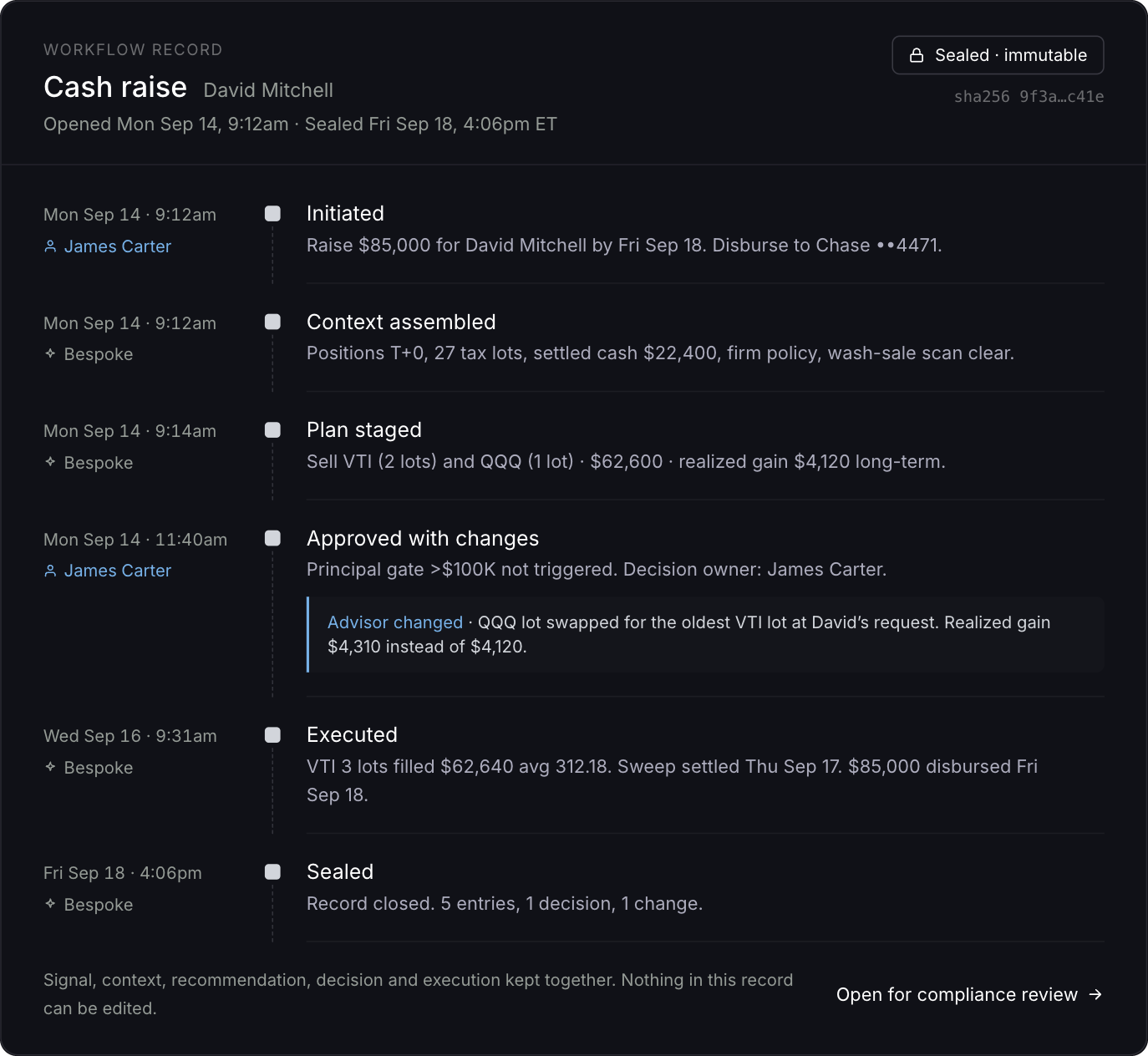
Signal, context, recommendation, decision and execution stay together.
Once a workflow is complete, its record is preserved as a definitive account of what happened.
Compliance can see the full path, including what was recommended, what changed, who approved it and when.
Start with best-practice workflows, then configure them to your firm, your advisors and your clients.
Sell loss lots clear of wash sales and stage replacements that preserve the intended exposure.
Identify portfolios outside their bands, build trades to the model, check them against the IPS and stage them for approval.
Calculate the required distribution for each account and stage the withdrawal for approval.
Build a review brief from performance, action items, life events and talking points in your firm’s format.
Identify the lowest-tax-cost lots and stage the sale needed to raise cash.
Identify concentrated positions and stage a tax-aware reduction sized to the household.
Identify excess cash and stage a plan to bring the household back toward its target allocation.
Each workflow takes a repeatable piece of how your firm works and turns it into a process that can run consistently across clients and advisors, with your rules, approval points, and controls built in.
Your models, policies and processes are built directly into the workflow, rather than left as instructions for someone to interpret.
The same process can run across households and advisors while still adapting to each client’s circumstances.